Showing posts with label Nuclear Boy Explains About Nuclear. Show all posts

Tuesday, 13 December 2011

Safety Design To Reduce Accident Risk

Nuclear plants operators all over the world have actively reviewed their safety policies and procedures as a result of the Fukushima accident. The occurrence of cascading failures in multiple reactor units is unprecedented and generates concerns about the existence of faulty emergency procedures, the presence of the design flaws, or both. The new design of Generation III reactors is relevant in the light of this accident but site considerations should be reviewed to be sure that natural risks or other external threats are correctly taken into account. Nothing is perfect but many things can be improved.
Concerns about the radiation and etc will be always in mind, but nuclear technologies has been developed for more than 60 years now, all the facilities are already there. In our opinion, this is all a very basic argument when a new technology is about to be implemented. What about damp that generates electric? Does it not destroy the rivers and forest? Every choice has its consequences and it’s just the matter of which one worth the risk. 
Residents, evacuated from the 20-kilometer exclusion zone around Tokyo Electric Power Co.'s Fukushima Dai-Ichi nuclear power station

Gravity, natural convection, and conduction instead of grid-powered, diesel-fueled, or battery back-up electricity, are among the key strategies that have emerged for tackling the challenge of nuclear plants' constant need for cooling power. Whereas Fukushima's backup systems did not survive the tsunami, newer reactors such as the ESBWR and the Westinghouse AP1000 could be better equipped to handle this type of event.

In addition, advanced passive designs which once approved by regulators could make boiling-water nuclear reactors 10 to 100 times safer than their active predecessors based on the core damage frequency metric, a calculation of the likelihood that an accident could cause the fuel in a given reactor to melt.Therefore, the improvement of the nuclear reactor is needed to ensure that the situation will not happen again. Generation III+ targets improved environmental protection (effluent discharge), passive safety systems, increased service lifetime, and lower operating and maintenance costs (but higher investment costs).

Thinking Man, Think Nuclear, Think Green.
The affected unit 1 reactor was due to be retired in Febuary 2011, but its license was extended for another 10 years beyond its initial 40 years operational time after a safety review and upgrades. In the USA licenses for operating plants are being extended by 20 years beyond their 40 years licenses to 60 years based on a detailed review of their safety operational level. 

Most of the components such as the steam generators have been replaced or renovated under these licenses extensions, except for the pressure vessels.Whether safety procedures were not followed at Fukushima, or if they did follow? Either way, we are going to have to beef up the procedures, so people take the right paths when they reach a crossroads or develop new crossroads that will lead you in the right direction. 

Now, please watch this simple but really meaningful video about nuclear accident that hit Fukushima. In this interesting video, the government tried to explain to people of Japan about what happened in Fukushima. I would like to mark the line "That's the least we can do for accepting the nuclear boy's energy for so many years, by praying". Wishing you the best of luck, Japan! From Malaysia, with love~


 "Don't worry, with each passing moment, the nuclear boy will get better and better"


Nuclear is a very good power source since it can provide highly reliable, competitive, stable and environment - friendly power supply.

Regards,
Nuclear Boy

Fukushima Meltdown

Japan generates 29% of its electricity from nuclear power plants. The facilities are designed to withstand earthquakes and tsunamis that are common in Japan, which generates its nuclear electricity from 54 nuclear power reactors at 17 plant. Nuclear reactors at the Fukushima Daiichi plant are of the Boiling Water Reactor (BWR) type which is one of the Generation II nuclear reactors.

A state of emergency was declared on Friday, March 11 2011 after a combined earthquake of magnitude 8.9 - 9.0 on the Ritcher scale (Click Here) near the east coast of Honshu and a tsunami event generating a 15 - 24m high wave. The earthquake event is designated as the Tohoku-Chihou-Taiheiyo-Oki earthquake.Official records dating back to the year 1600 inspired the mechanistic safety analysis design of the plant to withstand the strongest earthquake at the 8.6 magnitude level for the Fukushima prefecture.
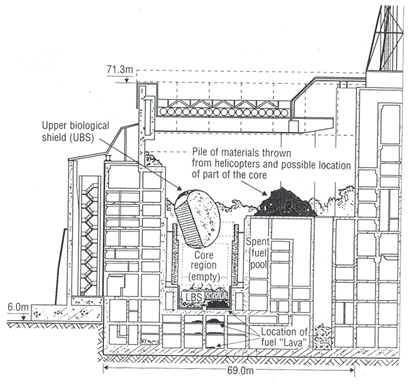
According to the plant design, the maximum probable height at Fukushima was at just 5.7 meters compared with the actual 14m. The earthquake triggered a shutdown of the 3 operating reactors at the site as designed. The 3 others were already shutdown for maintenance. There were 6,415 people at the site of which 5,500 were subcontractor. When the reactors were shutdown and the remaining decay heat of the fuel was being cooled with power from emergency generators. The subsequent destructive tsunami with waves of up to 14 meters disabled emergency generators required to cool the reactors. Over the following three weeks there was evidence of partial nuclear meltdowns in units 1, 2 and 3.Visible explosions, suspected to be caused by hydrogen gas, in units 1 and 3, with a suspected explosion in unit 2, which that may have damaged the primary containment vessel and a possible uncovering of the units 1, 3 and 4 spent fuel pools. Radiation releases caused large evacuations, concern about food and water supplies, and treatment of nuclear workers. 

When case of an earthquake happen the automatic control systems first and foremost would kill the sustained fission reaction that is going in the fuel elements. This was done at the Fukushima plant immediately by inserting the control rods and the nuclear reaction stopped. During normal operation in a BWR, the control rods are used to maintain the chain reaction at a critical state. The control rods are also used to shut the reactor down from 100% power to about 7% power (residual or decay heat).
 

Control Rods

The problem is that during the fission reaction one also produces a lot of short-lived nuclear isotopes. At this point, the cooling system has to carry away the residual heat, about 7% of the full power heat load under normal operating conditions. During that time, water is still being circulated through the reactor core in order to take away the heat produced in the decays of those short-lived isotopes. This is done via pumps that are operated via electricity from power grid or diesel generators or batteries.

After the earthquake, the grid was knocked out and the diesel generators got damaged. When the diesel generators failed after the tsunami, the reactor operators switched to emergency battery power. The batteries were designed as one of the backup systems to provide power for cooling the core for 8 hours. And they did. After 8 hours, the batteries ran out, and the residual heat could not be carried away any more.  Unfortunately, without an active removal of decay heat the reactor was adding heat to the water faster than it was taking it out, and the temperature was rising.  Because this was a reactor that operated on water that was already at its boiling point, this also meant that the pressure inside the reactor was rising as well. 


Apart from that, it appears that there were two hydrogen explosions in Units 1 and, recently, Unit 3. The hydrogen come from the chemical reaction when the reactor temperature exceeds 1000°C, the reaction of the zirconium alloy in cladding tubes with water generates large amounts of hydrogen in the name of oxidizing reaction. This oxidizing reaction produces hydrogen gas, which mixes with the gas-steam mixture being vented.  This is a known and anticipated process, but the amount of hydrogen gas produced was unknown because the operators didn’t know the exact temperature of the fuel rods or the water level. This hydrogen leaked and collected near the ceiling of the reactor buildings, and since hydrogen gas is extremely combustible, when enough hydrogen gas is mixed with air, it reacts with oxygen it caused immense explosions. This explosion destroyed the top and some of the sides of the reactor building, but did not damage the containment structure or the pressure vessel. While this was not an anticipated event, it happened outside the containment and did not pose a risk to the plant’s safety structures.


Japanese Spirit After Fukushima Accident
Japan continues to deal with the enormous task of cleaning up and moving forward after the 9.0 earthquake and tsunami that devastated the northeast coast. Local authorities are still dealing with the damaged Fukushima Daiichi Nuclear Power Plant, and due to weather condition, it could increase the risk of disease as workers clear away the debris, is approaching.
Kaisei Kubota and his grandmother Yae pray for victims in an area devastated by a tsunami in Miyako, Iwate prefecture, northeastern Japan, on Saturday June 11. Kaisei's father, a voluntary firefighter manning a water gate of a coastal levee, was killed after being swept away by a tsunami on March 11. Source: Kyodo News/Associated Press
A resident, evacuated from Namie town, right, undergoes a screening test for possible nuclear radiation after a brief visit to her home in the 20-kilometer exclusion zone around Tokyo Electric Power Co.'s Fukushima Dai-Ichi nuclear power station, in Minami Soma, Fukushima prefecture, Japan, on Saturday, June 11, 2011. About 80 percent of the city is within a 30-kilometer restriction zone around the plant, while 4,100 households lived in a full evacuation zone set up by the government within 20 kilometers of the plant.
In this combo of two photos, a sea coast is filled with destroyed houses and debris on March 12, 2011, one day after the devastating earthquake and tsunami hit the area, top, and the same area, bottom, with the houses and debris cleared as photographed on June 3.
There is a phrase in Japanese "Makeji Damashi" which means  the Undefeated Spirit. And spirit is one thing that runs in no short supply in Fukushima.
Regards,
Nuclear Boy

Monday, 12 December 2011

The Many Things That Go Wrong With Chernobyl


A statue of Vladimir Lenin stands in the middle of a small park in the port of Chernobyl near the frozen river of Pripyat on January 29, 2006 in Chernobyl, Ukraine. The Chernobyl Port was abandoned soon after the 1986 Catastrophe.

Design Error
The RBMK reactor core is unstable at low power which is below 700 Megawatts-thermal, about a quarter of full power. In this condition the reactor is difficult to control and any tendency toward a runaway chain reaction is automatically and rapidly amplified. This very dangerous feature is characteristic of the RBMK design. The Chernobyl explosion occurred during a test at low power, that is, at a moment when the reactor was unstable. The Soviet authorities were warned well before the Chernobyl accident, but the warning fell on deaf ears. Deaf ears, what have you done?

 A guide holds a Geiger counter showing radiation levels 37 times higher than normal as a woman takes a picture in front of the sarcophagus of the destroyed fourth block of the Chernobyl nuclear power plant on September 16, 2010.

Before the Chernobyl accident happened there were a few minor failures where any of these could just have caused the initiating event for this or an almost identical accident. They included:

-    Pump failure- disturbance of the function of coolant pumping or pump cavitations, combined with the effect of the positive void coefficient. Any of these causes could have led to sudden augmentation of the effect of the positive void coefficient.

-     Failure of zirconium- alloy fuel channels or of the welds between these and the stainless steel piping, most probably near the core inlet at the bottom of the reactor. Failure of a fuel channel would have been a cause of a sudden local increase in void fraction as the coolant flashed to steam; this would have led to a local reactivity increase which could have triggered a propagating reactivity effect.

  Graffiti is seen on a wall of one of the buildings in the ghost city of Pripyat, near Chernobyl nuclear power plant on February 22, 2011.

Control rods and Safety design- The control rods of an RBMK reactor are inserted into the reactor core from above, except for 24 shortened rods which are inserted upwards and which are used for flattening the power distribution. A graphite rod termed a 'displaced is attached to each end of the length of absorber of each rod, except for twelve rods that are used in automatic control. 

The lower displacer prevents coolant water from entering the space vacated as the rod is withdrawn, thus augmenting the reactivity worth of the rod. The graphite displacer of each rod of all RBMK reactors was, at the time of the accident, connected to its rod via a 'telescope', with a water filled space of 1.25 m separating the displacer and the absorbing rod. The dimensions of rod and displacer were such that when the rod was fully extracted the displacer sat centrally within the fuelled region of the core with 1.25 m of water at either end. 

 Part of the collapsed roof at the Chernobyl nuclear plant, damaged in a fire, is pictured in this photo taken, Friday, Oct. 13, 1991 in Chernobyl, Ukraine during a media tour of the facility.

On receipt of a scram signal causing a fully withdrawn rod to fall, the displacement of water from the lower part of the channel as the rod moved downwards from its upper limit stop position caused a local insertion of positive reactivity in the lower part of the core. The magnitude of this 'positive scram' effect depended on the spatial distribution of the power density and the operating regime of the reactor. 

The control rods do not have a great emergency system. A fast insertion of control rods is needed in the critical situation. But in the RBMK reactor the control rods are inserted slowly. The reactor takes about 20 seconds for full insertion, while it takes less than 2 seconds in other reactors throughout the world.  This is much too slow to prevent runaway of the core while it is operating in the unstable mode. 

 The damaged Chernobyl unit 4 reactor building

Size of reactor - Owing to the largeness of the reactor core which is height 7 m and the diameter is 11.8 m the chain reaction in one part of the core is only very loosely coupled with that in other, distant, regions. This leads to a requirement to control the spatial power distribution almost as if there were several independent reactors within the core volume. 

This situation in extreme conditions can be highly unstable, because small spatial re distributions of reactivity can cause large spatial re distributions of the power. One manifestation of this decoupling of the core is that just prior to the accident the chain reactions in the upper and lower halves of the reactor were preceding almost independently, a situation that was exacerbated by heavy xenon poisoning in the intervening central region. 

Lt. Colonel Leonid Telyatnikov, Head of the Pripyat Fire Brigade which fought the Chernobyl blaze, points at a photograph of the power station's damaged fourth reactor following the April 26, 1986 nuclear accident. The reactor has since been entombed in concrete. 

 
A Soviet-designed and built graphite moderated pressure tube type reactor, using slightly enriched (2% U-235) uranium dioxide fuel. It is a boiling light water reactor, with two loops feeding steam directly to the turbines, without an intervening heat exchanger.

When control and safety rods were inserted from fully withdrawn positions under these circumstances, the positive scram effect discussed earlier could cause the lower part of the core to become super-critical and the neutron distribution to shift quickly downwards irrespective of the distribution just prior to rod insertion. Under the conditions of the accident, the shift in power distribution resulting from the positive scram could be substantial.

Sub - cooling of the inlet water-The RBMK reactors are boiling water reactors. The coolant enters the reactor core from below as water, sub - cooled below the boiling temperature, and boiling begins at some distance along the flow path through the core. Analysis and experiment have shown that the amount of sub - cooling of the entry coolant of a boiling water reactor is important for the stability of the reactor.

If the sub - cooling falls to near zero, boiling begins almost at the core inlet and, because of the void coefficient of reactivity, reactivity effects become very sensitive to the inlet coolant temperature. Furthermore, since there is not much change in fluid temperature between the coolant pumps and the core inlet, the temperature of the water in the pumps and at their intakes is near boiling if the sub - cooling is very small. Pump behavior under these circumstances can become erratic, and pumping action can be reduced substantially or can even stop completely under some conditions.

 A Kurchatov Nuclear Institute worker walks in the light streaming into the cement-entombed room of the Chernobyl nuclear power plant's exploded reactor on Friday, Sept. 15, 1989, three years after the nuclear disaster.

The most important characteristic of the RBMK reactor is that it possesses a "positive void coefficient". The steam bubbles are called voids, and that proportion of the coolant volume. The changes of void fraction also affected the changes in reactivity and it must be offset by control rods. 

This means that if the power increases or the flow of water decreases, there is increased steam production in the fuel channels, so that the neutrons that would have been absorbed by the denser water will now produce increased fission in the fuel. However, as the power increases, so does the temperature of the fuel and this has the effect of reducing the neutron flux (negative fuel coefficient). The net effect of these two opposing characteristics varies with the power level. At the high power level of normal operation, the temperature effect predominates, so that power excursions leading to excessive overheating of the fuel do not occur. 

However, at a lower power output of less than 20% the maximum, the positive void coefficient effect is dominant and the reactor becomes unstable and prone to sudden power surges. This was a major factor in the development of the accident. (Click Here) The increasing of void coefficient reactivity and the less number of fixed absorbers in the core were the other causes of Chernobyl accident. The fuel enrichment in the reactor was set at only 2% and it should be increased by 0.4% in order to have better operating system. The additional absorbers require the use of higher fuel enrichment to compensate for the increased neutron absorption.  

A Kurchatov Nuclear Institute worker stands in the operators room of block number four Chernobyl's nuclear power plant inside the sarcophagus on Friday, Sept. 15, 1989, three years after the nuclear disaster.

In the event of coolant loss, water in the pressure tubes turns to steam and steam pockets, or voids, is formed. Steam is less dense than water and has less cooling power, so the fuel gets hotter. However, where the water also provides the moderating function, the neutrons will speed up due to the lack of moderation and the reaction will slow down. 

This is known as a negative void coefficient, and ensures that any uncontrolled increase in core temperature will slow down and ultimately stop the reaction. Most reactors are built this way and are thus inherently 'safe.' Conversely, in the RBMK at lower power levels (less than 20% of maximum) the graphite moderator allowed the reaction to proceed in spite of the loss of coolant. The number of free neutrons would increase, as there is no water to absorb them. This positive void coefficient meant that an uncontrolled temperature increase could, in the right circumstances, lead to a runaway reaction.

Equipment- The reactor is equipped with a fuel rod leak detector. A scintillation detector, sensitive to energies of short-lived fission products, is mounted on a special dolly and moved over the outlets of the fuel channels, issuing an alert if increased radioactivity is detected in the steam-water flow.

Reactor Poor Protection and Emergency System- In RBMK reactors have neither a system to filter exhausted gases nor a containment structure. In the worst of scenarios, the latter would at least have reduced and slowed the escape of radioactive material into the environment. Such a containment structure protects reactors all over the world, including the most recent reactors (VVER 1000) installed in the former Soviet Union. 

 A nurse at a children's health clinic in Warsaw administers an iodine solution to a three-year-old girl held in her mother's arms in Poland, May 1986. Protective measures were taken for possible radiation poisoning from the Soviet nuclear accident in Chernobyl. 

The reactor at Three Mile Island was so enclosed and consequently there was no significant release of radioactivity. Lacking a containment structure, the RBMK reactor is like a bus without a body - the containment structure is obviously a major and essential safety requirement, although it is not invulnerable. The lower operating reactor margin (OMR) which is 26-30 rods was the factor that leads to the accident. 

This should be increase to 43 – 48 rods. With the increment of the number of fixed absorbers and the ORM it helps to reduce the value of the void coefficient of reactivity to +ß (where ß is the effective delayed neutron fraction). Yet the magnitude of the ORM was not conveniently available to the operator, nor was it incorporated into the reactor's protection system. In the discussion of the scenario, the operators seemed not to be aware of the other reason for the importance of the ORM, which was the extreme effect it could have on the void and power coefficients.

The computer system does not have an emergency mode in calculating and collecting data of reactivity margin. The searching data scale is too large and it takes almost ten to fifteen minutes to cycle through all the measurements and calculates the results. 
 
Error Committed By the Operating Crew 
Six human errors were identified.  Two permanent operating rules were violated:  not to run the reactor for any length of time at reduced power level and never to have fewer than thirty control rods fully inserted into the core.  One error consisted of not following the test procedure, and three safety mechanisms were deliberately bypassed - one for emergency water injection, and two others for emergency shut-down. 

It is evident that the operators were not adequately trained and did not realize the dangerous nature of their actions.  If any one of these six errors had not been committed, the explosion would not have occurred. On the other hand, it would be too easy to lay the blame for the catastrophe on the operating crew because they were doing their job with the training they had received. 

That training was insufficient and totally inconsistent with absence of passive safety features in the RBMK reactor design. Not knowing much about the behaviour of the reactor core, they were unable to appreciate the implications of the decisions they were making, and their situation was even more dangerous in that the test was being done at low power and in violation of standing orders. Furthermore, the operating instructions, both the standing orders and the specific instructions for the test, were incomplete and imprecise.

 A general view of the Chernobyl nuclear power plant.
  
The world nuclear power industry is quick to point out that the Chernobyl accident was a unique event that could never be repeated at a Westinghouse, General Electric, Babcock and Wilcox or Combustion Engineering design. The industry claims that Chernobyl was the product of a severely flawed reactor design that could never be licensed to operate in the Malaysia. Industry proponents continue to claim that all nuclear reactors are designed to ensure that radioactive materials would be contained in the event of a serious accident.

 We must learn from the past to be smarter for the future.

Regards,
Nuclear Boy.

Thursday, 8 December 2011

Chernobyl Accidents

Chernobyl is a small town in the Ukraine, near the border of Ukraine and Belarus, that was all until the Saturday, 26th April 1986 completely unknown city and after that became synonym for disaster, all because of the explosion inside the nuclear reactor which had caused the biggest nuclear disaster in history of the mankind. The nuclear power plant itself wasn't located in Chernobyl but in fact 18 km northwest of the city of Chernobyl, near the town of Pripyat and was consisted of four reactors of type RBMK-1000, of which reactor Number one was commissioned in 1977 and fatal reactor Number four in 1983. (Click Here)

Chernobyl power station with these four reactors combined produced about 10% of total Ukraine's electricity. The explosion itself was major issue in all the world media and the great fear in safety of soviet nuclear stations arise. Even the Soviet government, under pressure of the world media had to reveal the mystery veil from their nuclear projects since further explosion, all caused by the primary explosion inside the nuclear reactor, had spread radioactive cloud outside the Soviet border and into the east, west and north Europe and even in the some parts of the North America.

 An aerial view of the Chernobyl nuclear power plant (May 1986 photo)  after the April 26 explosion in Chernobyl, Ukraine. In front of the chimney is the destroyed 4th reactor. Behind the chimney and very close to the 4th reactor is the 3rd reactor.(Click to Enlarge)


The facility had been built during the 1970s using a design that lacked some of the safety features in many other nuclear power plants. Most notably, Chernobyl's reactors were not enclosed in sturdy containment buildings, like the massive concrete domes seen at other nuclear plants. Such shells are able to trap any radiation that accidentally escapes from the reactor core, the site of the nuclear fuel. In the former Soviet Union at least 9 million people have been affected by the accident; 2.5 million in Belarus; 3.5 million in Ukraine; and 3 million in Russia. In total over 160 000 Km2 are contaminated in the three republics. 

As far away as the United Kingdom, restrictions are still placed on the movement and slaughter of sheep. In January 1996 these restrictions were still in place in 219 farms effecting 317,400 sheep and covering more than 1097 km2. The accident at Chernobyl was due to multiple operating mistakes that compounded the serious design flaws. Therefore, the safety culture actually is very important to prevent unwanted accident to be happening.

 Repairs are carried out on the Chernobyl nuclear plant in Ukraine on October 1st, 1986, following a major explosion in April 1986 which, according to official statistics, affected 3,235,984 Ukrainians and sent radioactive clouds all over Europe. 

The Number 4 reactor of the Chernobyl nuclear power plant in the Soviet Ukraine suffered a power excursion on April 26, 1986. The accident happened during the effects test of running the reactor at low power. To perform the test, one of the important control systems was switched off and in order to allow the reactor to reach unstable and low power condition. An unplanned decision from a deputy chief engineer who gave an order to lift the control rods to speed up the reaction proved to be the biggest mistake. 

This mistake has caused the water reactor drained and began to overheat. The tremors are felt and in panic situation, all the control rods were lowered and suddenly it jammed. This event has lead to another problem. The power in the reactor was increased abruptly about 100 times from its nominal value. The light water coolant, no longer able to carry off the enormous amount of heat generated, evaporated in a fraction of seconds, leading to a steam explosion. 

The reactor was destroyed. In the following ten days or so, about 300 Mega Curies of radioactive isotopes injected into the atmosphere, significantly contaminating an area of about 150 000 square inhabited by some 6 million people. It also caused a measurable increase in the level of ionizing radiation in most of Europe.Unfortunately, the accident happened because of the violation of the safety regulation by the operator. Other cause such as the unsafe reactor design has also contributed to this accident.


 A military helicopter sprays a decontaminating substance over the region surrounding the Chernobyl nuclear power station a few days after its No. 4 reactor's blast.

A graveyard for vehicles highly contaminated by radiation, near the Chernobyl nuclear power plant, seen on Nov. 10, 2000. 

A view of the Chernobyl nuclear power station is seen from Ukraine's ghost town of Pripyat, April 13, 2006.

This condition turned from bad to worst with the potential of reactor’s breakdown and explosion occurred. The event was related with the design of nuclear reactor. The Reaktor Bolshoy Moshchnosti Kanalniy (RBMK) was built with a class of graphite-moderated and cooled by light water. The moderator blocks are made of nuclear graphite of dimensions 250×250×500 mm.(Click Here) The control rod design was identified as unsafe.

Discussing about the control rods design, the RBMK at Chernobyl had manual control rods. Some RBMK designs did include control rods on electromagnetic grapples, thus controlling the reaction speed and, if necessary, stopping the reaction completely. Thus with the design it can reduce the fission rate before it gets too high. The reactor also has an unsafe void coefficient. For the test, the reactor should have been stabilized at about 1 000 MWt prior to shut down, but due to operational error the power fell to about 30 MWt. 

When the operational error happened, the void coefficient of reactivity was so positive that it overwhelmed the other components of the power coefficient, and the power coefficient itself became positive. When the power began to increase, more steam was produced, which in turn lead to an increase in power. The additional heat resulting from the increase in power raised the temperature in the cooling circuit and more steam was produced. 

More steam means less cooling and less neutron absorption, resulting in a rapid increase in power to around 100 times the reactor's rated capacity. There was an increase in coolant flow and a resulting drop in steam pressure. At about this time, the operators reduced the flow of feed water, presumably to maintain the steam pressure. The automatic trip which would have shut down the reactor when the steam pressure was low had been circumvented.

Another unplanned decision was made by the operator in charge. In order to maintain power the operators had by switching off the automatic regulators and freeing all the control rods manually. The reactor became very unstable where the operators could not prevent an overwhelming power surge and had to make adjustments every few seconds trying to maintain constant power.

 A close view of reactor number 4 of Chernobyl nuclear power plant in this May 10, 2007 picture, with the Chernobyl Monument, left, erected in 2006.

 In this Nov. 10, 2000 photo, the control room with its damaged machinery, is seen inside reactor No. 4 in the Chernobyl nuclear power plant.

An employee of the Chernobyl Nuclear Power Plant walks in the control room of the destroyed 4th block of the plant on February 24, 2011.


 A raven stretches its wings as it sits on a post inside the 30 km (18 miles) exclusion zone around the Chernobyl nuclear reactor near the village of Babchin, Belarus on December 23, 2009. The sign reads: "Radiation hazard".

Explosion was the next event happed after the failure of reactor design. The control rods are made of boron carbide with a graphite tip. When the control rod is first inserted, the graphite tip increases the reactivity. Graphite also consists in the reactor’s neutron moderator about 600 tones. Unfortunate property of that material leads to a huge explosion. This is happened due to very hot graphite comes into contact with air then it bursts into flames and the fire burned for 10 days. 

At Chernobyl the graphite fire vaporized the radioisotopes in the reactor and dispersed them in the atmosphere together with the smoke. The accident caused the deaths of thirty one persons due to the acute effects of the explosion.  The explosion killed two members of the operating crew. Additional for the accident it has created fear to human nation due to radiation effect. 

There were 134 persons who were acutely irradiated and from that number 28 died in the three months following the accident. In response, the authorities evacuated, in 1986, about 115,000 people from areas surrounding the reactor and subsequently relocated, after 1986, about 220,000 people from Belarus, the Russian Federation and Ukraine.


In conclusion, the Chernobyl accident resulted from a combination of external circumstances, engineering design flaws and errors made by badly trained operators. The test was started at extreme operating conditions. Closing the valve to the turbines increased boiling of the coolant. The positive void coefficient started a power excursion which accelerated when the poisoning of the core decreased as the flux increased.

This could have been stopped by the control rods, had they not been too far out of the core, as well as badly designed. Instead, the control rods delivered the final blow. The fuel rods went white-hot and shattered. The hot fuel made the water dissociate into hydrogen and oxygen. The cooling system exploded from the pressure of the steam, then the hydrogen could react with the air outside and there was a chemical explosion.

 
The Chernobyl accident had a disastrous impact on life, health and the environment especially in Ukraine, Belarus and Russia and prompted fear and concerns in other nations of the world about the effects of radiation. In addition, it has had a negative impact on the health of the hundreds of thousands of people involved in the clean-up and those who still live in heavily contaminated areas. Therefore, safety culture needs to be improvising for the future planning of the development nuclear power plant. This is to ensure that there is no other future accident happened again. 

 General view of Ukraine's ghost town of Pripyat, April 13, 2006. 

An abandoned house seen in the deserted village Redkovka, some 35 km (22 miles) from Ukraine's Chernobyl nuclear power plant, Thursday, March 30, 2006.

  A Ukrainian man with a dog walks in a street in the ghost town of Chernobyl, April 13, 2006.


"It is unlikely that we can meet our aggressive climate goals if we eliminate nuclear power from the table.  However, there is no future for expanded nuclear without first addressing four key issues: public right-to-know, security of nuclear fuel and waste, waste storage, and proliferation."  - Barack Obama,


Regards,

~Nuclear Boy~

Friday, 18 November 2011

How Does Nuclear Energy Works?

Hello! Nuclear Boy is here again! Do you want to know how does nuclear energy works? Let's watch this exciting video!


And now you must be confused what is fission and fusion. Want to know more about these two processes? This video explains how does fission and fusion work. Come on! Let's watch another exciting video with Nuclear Boy!


Nuclear Boy will post more exciting information about Nuclear Energy. Stay Tune!